Free drug paraphernalia cleanup tool
Drug Paraphernalia Cleanup DIY or Call a Pro? Risk Check
Eight yes-or-no questions that produce a risk level and explain when professional help is the safer choice.
Sometimes an owner with gloves, tongs, and an approved sharps container can safely handle a single item. Far more often, trying to save money on a cleanup leads to a needle stick, an exposure, or a legal risk that costs much more. The DIY or Call a Pro Risk Check asks eight yes-or-no questions that sort out those cases. Did you see any powder or unknown substance? Are there needles, and can you see all of them? Is there blood, vomit, or another body fluid? Are there signs of drug making? Is the material on carpet, a seat cover, or a mattress? Will children, pregnant people, or people with health problems use the space? Is this a rental, motel, or company vehicle where paperwork matters? Do you have a sharps container and proper gloves on hand?
The result is a risk level with a plain note on which answers drove it. The tool is not trying to talk everyone into hiring a company. It is trying to make sure you understand what you would be taking on. Think of a single capped needle on a hard floor in your own home. That is a different problem from a stained mattress and a baggie of powder in a unit you plan to rent again. The note also points out what a pro brings that a careful amateur does not. That includes careful searches of hidden gaps, wet methods that keep residue out of the air, regulated disposal, and a written record. That record protects you if the next tenant asks what happened here.
How to use it
- 1Answer each of the eight questions based only on what you observed from a safe position.
- 2Read the risk level and the explanation of which factors pushed it up or down.
- 3If the result leans toward a pro, use the vetting checklist and cost estimator to get ready for that call.
- 4If the result says limited DIY is reasonable, follow the safety notes exactly. Stop if anything unexpected turns up.
Prefer to ask a person?
Your request is sent to the follow-up inbox. A coordinator can reply by email. Not for emergencies; call 911 first if anyone is in danger.
Check whether DIY is safe
Drug Paraphernalia Cleanup: DIY or call a pro?
Eight yes-or-no questions. The result is an educational risk level, not a safety clearance.
1. Is there blood, body fluid, or anything that could carry a bloodborne pathogen?
2. Has the material soaked into carpet, padding, a mattress, drywall or a subfloor?
3. Is there a strong or lingering odor?
4. Could needles, broken glass, drug residue or unknown chemicals be present?
5. Does the affected area cover more than a small spot, or more than one room?
6. Will children, older adults, pregnant people or anyone immunocompromised use the space afterward?
7. Do you need documentation for insurance, a landlord, a sale, or an estate?
8. Would you be doing this while grieving, exhausted or under time pressure?
8 questions left to answer.
A worked example
Here is an invented example. A homeowner finds one used needle, with its cap on, on the concrete floor of her separate garage. A relative had stayed there. She answers the risk check. There is no powder. There is one needle, and she can see the whole floor. There are no body fluids, no signs of drug making, and no soft materials. No one at higher risk uses the garage. It is not a rental. And yes, she has heavy gloves and can buy a sharps container. The tool gives a lower risk level. It explains that one needle in plain sight on a hard surface, with the right gear, is at the manageable end. It reminds her to use tongs, never recap or bend the needle, seal the container, and check the local drop-off rules. Now take her neighbor, a landlord with an empty unit. It has foil, several needles in a couch, a dusting of white powder on a nightstand, and a stained carpet. His answers put powder, hidden needles, soft materials, a rental that needs paperwork, and possible body fluids all in the yes column. The tool gives a high risk level. It explains that hidden needles, the risk of residue in the air, and the need for a solid turnover file each justify hiring a pro on their own.
Numbers behind diy risk check decisions
- 0 of 274
Across 274 children injured by discarded needles in Montreal over 19 years, there were zero HIV, hepatitis B or hepatitis C seroconversions.
Read with care: Many children received prophylaxis, and not all were tested at six months.
Source: Pediatrics (Papenburg et al.) (2008)Two Montreal children's hospitals, 1988–2006
- HBV 2–40%; HCV 3–10%; HIV 0.2–0.5%
The Canadian Paediatric Society cites occupational needlestick transmission risks of 2–40% for hepatitis B, 3–10% for hepatitis C and 0.2–0.5% for HIV from a known-positive source.
Read with care: Community-discarded needles carry far lower risk because blood is old, dried and often absent.
Source: Canadian Paediatric Society (2018)Occupational hollow-bore needlestick data applied to community exposures
- 14.3 per 100,000
The US age-adjusted rate of overdose deaths involving synthetic opioids other than methadone, mainly fentanyl, fell 35.6% from 22.2 per 100,000 in 2023 to 14.3 in 2024.
Read with care: A decline in deaths does not mean fewer paraphernalia or residue scenes.
Source: CDC National Center for Health Statistics (2025)United States, final 2023 and 2024 mortality data
- 9.0%
Xylazine was detected in 9.0% of 53,969 fentanyl-involved overdose deaths across 32 jurisdictions from January 2021 to June 2022, rising to 10.9% of deaths by June 2022.
Read with care: Detection depends on toxicology testing practices, which vary by jurisdiction.
Source: CDC MMWR (2023)32 US jurisdictions, 2021–2022
These figures are public research and agency data, not this network's own job records. Keep each number with its population, year and limits; none of them predicts cost, timing or outcome at a specific property.
DIY or Call a Pro? Risk Check questions for drug paraphernalia cleanup
Why does one visible powder answer push the result so hard toward professional help?
Because you cannot tell what a powder is by looking at it. Some fentanyl-type drugs are dangerous in tiny amounts if they get into the air. Wet methods, breathing protection, and careful glove changes keep residue out of the air and off skin. Without that training and gear, even a small amount on a nightstand is a hazard worth handing off.
Can I do part of the work myself and hire a provider for the rest?
Sometimes, and the tool's explanation can help you decide which parts. Removing ordinary trash after a provider has completed the sharps sweep and residue cleaning is a common split. Doing the sweep yourself and calling a provider for the rest is not, because the sweep is where the injuries happen and where hidden items are missed.
Does a low risk result mean the space is safe?
It means the specific situation you described appears manageable with basic precautions. It does not mean there is nothing else in the room. If you begin and find a second syringe, powder, or a stain you did not notice, stop and rerun the check. The result is only as good as the observations you fed into it.
How does the tool treat a company vehicle?
A vehicle gets yes for the paperwork question when it belongs to an employer or will go back to a fleet. It usually gets yes for soft materials too, because of seats and carpet. Those two factors, along with hidden gaps where needles collect, tend to push the result toward hiring a pro. That holds even when only a little debris is visible.
What equipment does the tool assume for a DIY-leaning result?
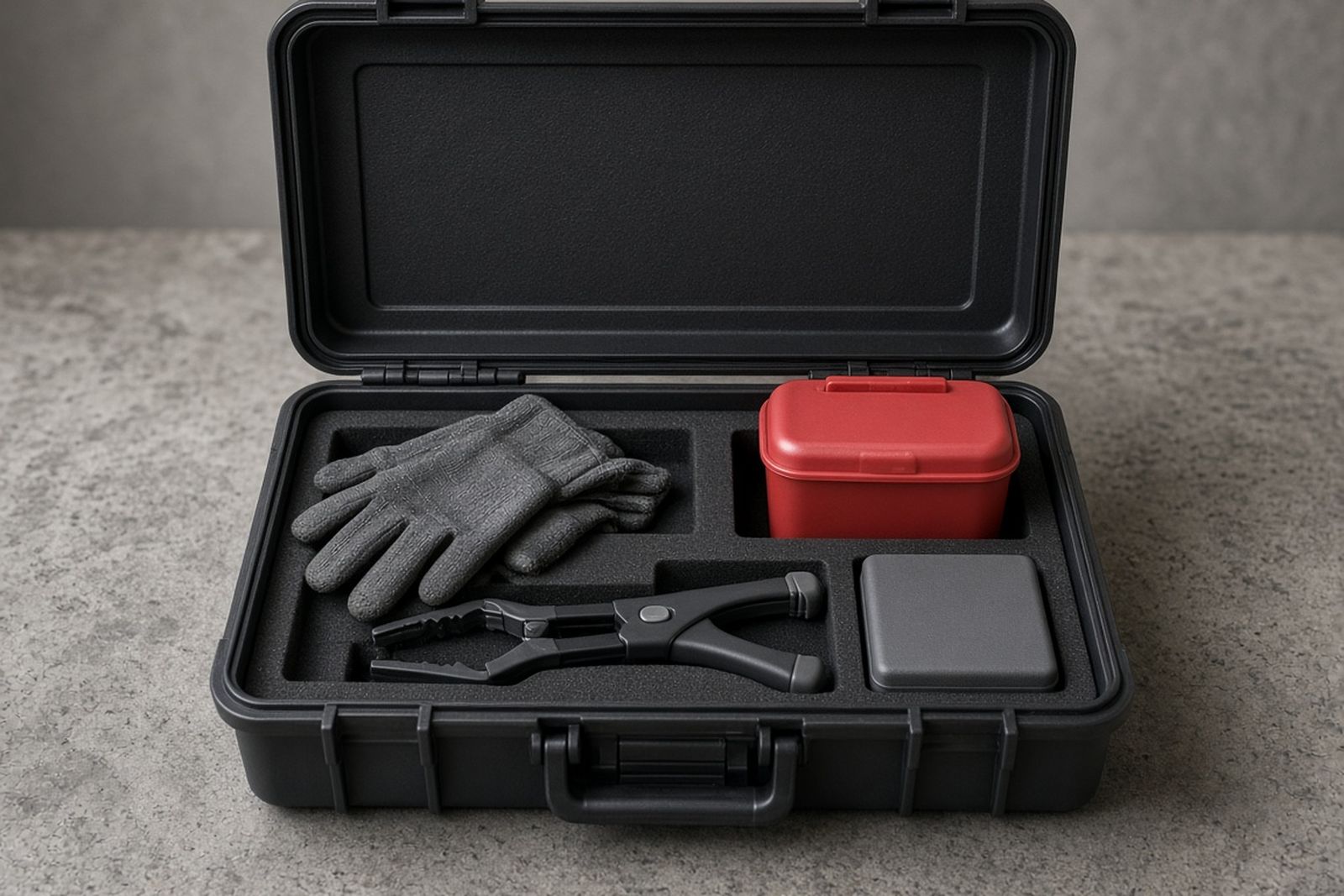
At the least, it assumes gloves that needles cannot poke through, tongs or a grabber, an approved sharps container, and eye protection. It also assumes a disposal plan you have checked with the local authority. If you lack any of these, the tool notes that the risk level goes up. It never assumes that trash bags, kitchen gloves, or a broom are good enough for anything on this kind of job.
Should I rerun the risk check if the situation changes during the day?
Yes. The result reflects only what you knew when you answered. Run it again with new answers if you find another item or notice a stain. Do the same if you learn a child will stay in the space, or you realize you do not have a sharps container. A job that looked manageable in the morning can lean toward a pro by afternoon. The check is quick enough to repeat whenever something changes.
Can a tenant use the risk check for paraphernalia found in a rental?
A tenant can use it to understand the risks. But in most rentals, the landlord is responsible for hazards in the unit and shared areas. If you found items left by a past tenant or in a shared space, the usual first step is to tell the landlord in writing and send photos. If the items belong to someone in your own home, the check can help you decide what to handle and when to ask for help.
Related community polls
Every count is a real visitor vote; nothing is seeded or padded. One vote per poll per device, and you can change your answer.
You open a vacated rental and see foil, a pipe, and one syringe. What is your first move?
Which hazard worries you most in a unit with drug debris?
Other drug paraphernalia cleanup tools
Cost Range Estimator
Set the affected area, surface types, severity and extras to see an educational cost range and the factors that move it.
OpenProvider Vetting Checklist
Fifteen questions to ask any remediation provider, a readiness score, and a copyable list of what is still unanswered.
OpenInsurance Claim Organizer
A guided checklist from finding the policy to tracking the carrier decision, with a printable summary of where the claim stands.
OpenFirst 24 Hours Planner
Tell the planner a few facts about the situation and get an ordered list of who to call, what not to touch, and what to photograph.
OpenWaste & Disposal Classifier
Five questions about the material point to the likely waste category and which authority to confirm the rules with.
OpenMore on drug paraphernalia cleanup
Drug Paraphernalia Cleanup services
See how needle pickup, residue cleaning, vehicle work, and turnover paperwork fit together, and what to expect from a company on site.
Costs explained
What drives the price, published cost ranges, and how to read a written quote line by line.
Insurance and payment
Which policies may respond, how to document a claim, and what to do if coverage is denied.
Community polls
Compare your gut calls with other owners and managers on police reports, what to tell tenants, who pays, and when lab testing is worth it.
Knowledge quiz
Test whether you would make the safer call when you find foil, pipes, syringes, or unknown powder, then review the study guide.
Articles and resources
Read longer articles on getting a unit ready after drug use, safe cleaning when fentanyl may be present, and how to tell drug use from drug making.