Short answer
A defensible drug paraphernalia cleanup scope ties every task to something observed, names who approves changes, separates search and removal from cleaning and testing, and defines the condition that allows re-entry. This illustrative example follows a hypothetical motel room from discovery to closeout so you can see how each decision is recorded and why vague scopes lead to disputes and missed hazards.
Why one motel room, in detail
Checklists are useful, but they hide the reasoning. A scope is really a series of judgment calls: what to search, what to remove, what to clean, what to test, and when to stop. Seeing those calls made in sequence helps you recognize a strong scope when a provider hands you one, and a weak one when something important is missing.
Everything below is hypothetical. The property, the people, and the findings are invented for teaching purposes. No outcome, timeline, or cost here should be read as typical, and nothing here describes a real client. The goal is to show the thinking, not to promise a result.
As you read, notice how often the scope refers back to something that was actually seen or documented. That habit is what makes a scope defensible. When an owner, insurer, or future guest asks why a mattress was discarded or a wall was repainted, the answer should be sitting in the file.
What the housekeeper found
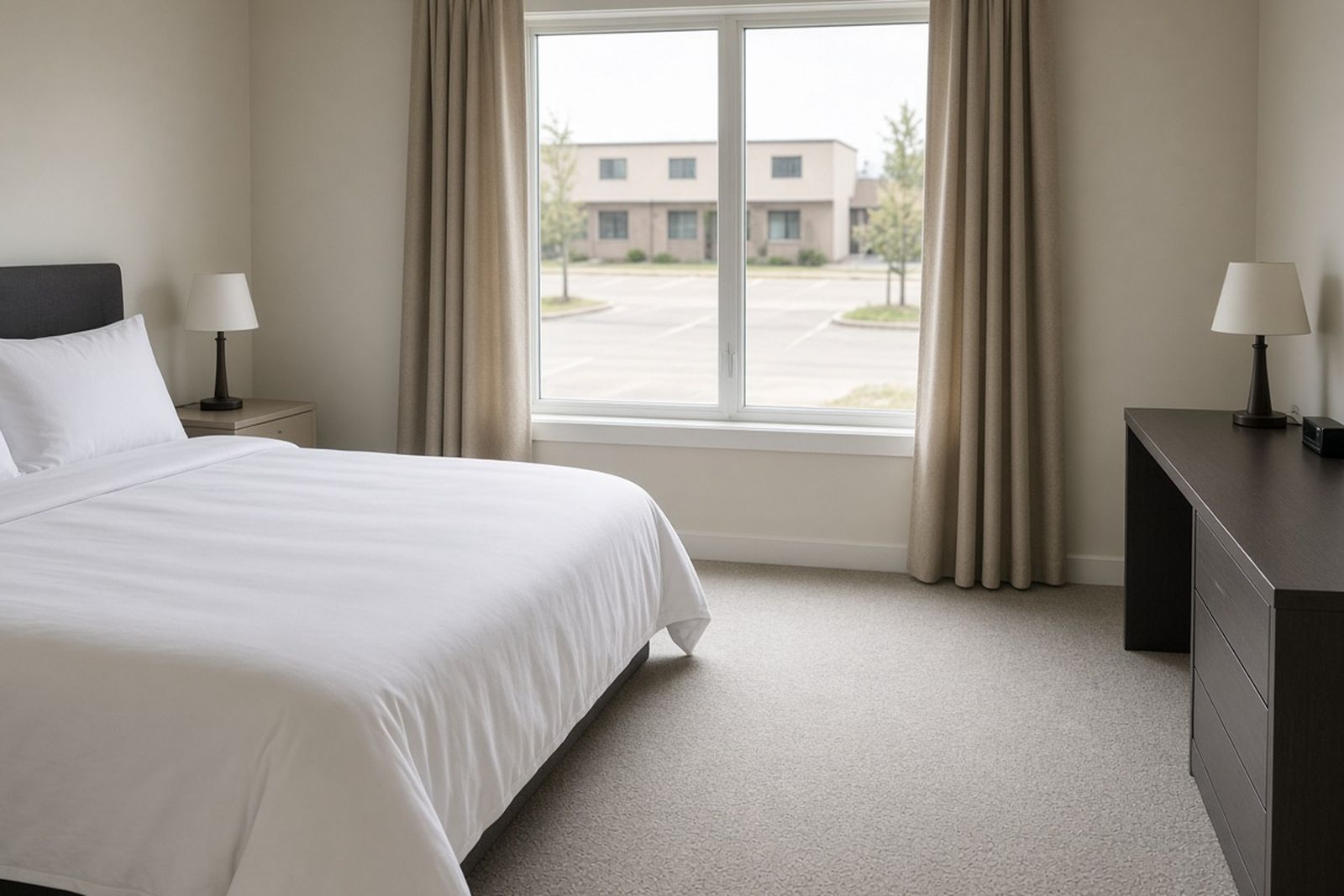
In this hypothetical, the owner of a small independent motel receives a housekeeping report about room 14. A guest checked out early. The housekeeper opened the door, saw several uncapped syringes on the nightstand, burnt foil and a lighter on the bathroom counter, and a small open bag with white powder on the floor near the bed. She backed out and closed the door.
The owner's first steps
The owner does three things right away. She locks the room and removes its key cards from circulation. She asks the housekeeper whether she touched anything or was stuck, and confirms she was not. She writes a short note with the time, the room number, and what the housekeeper described, and takes two photos from the doorway without entering.
Because of the powder and the number of syringes, she calls the non-emergency police line to ask whether officers want to see the room. They decline to respond for personal-use items and tell her she may proceed. She notes the call, the time, and the name of the person she spoke with.
Drawing the boundaries of the scope
When the provider's lead arrives, the first scoping question is geographic. Room 14 is obviously included. But the lead asks where else the guest might have been: the ice machine alcove, the exterior trash can by the stairs, the guest's parking space, and the adjoining room if there is a connecting door.
The owner confirms there is no connecting door. She agrees to add the exterior trash can and the walkway directly outside the room, since housekeeping reported seeing a syringe cap on the walkway earlier in the week. The parking area is excluded because it was swept that morning and nothing was found.
The written scope lists room 14 including the bathroom and closet, the exterior walkway from the stairs to the room door, and the trash receptacle at the base of the stairs. Anything else requires written approval from the owner, who is named as the only person authorized to expand the work.
- Room 14, bathroom, and closet.
- Exterior walkway from stairwell to room door.
- Trash receptacle at the base of the stairs.
- Owner named as sole approver for any additions.
Search and removal as a separate phase
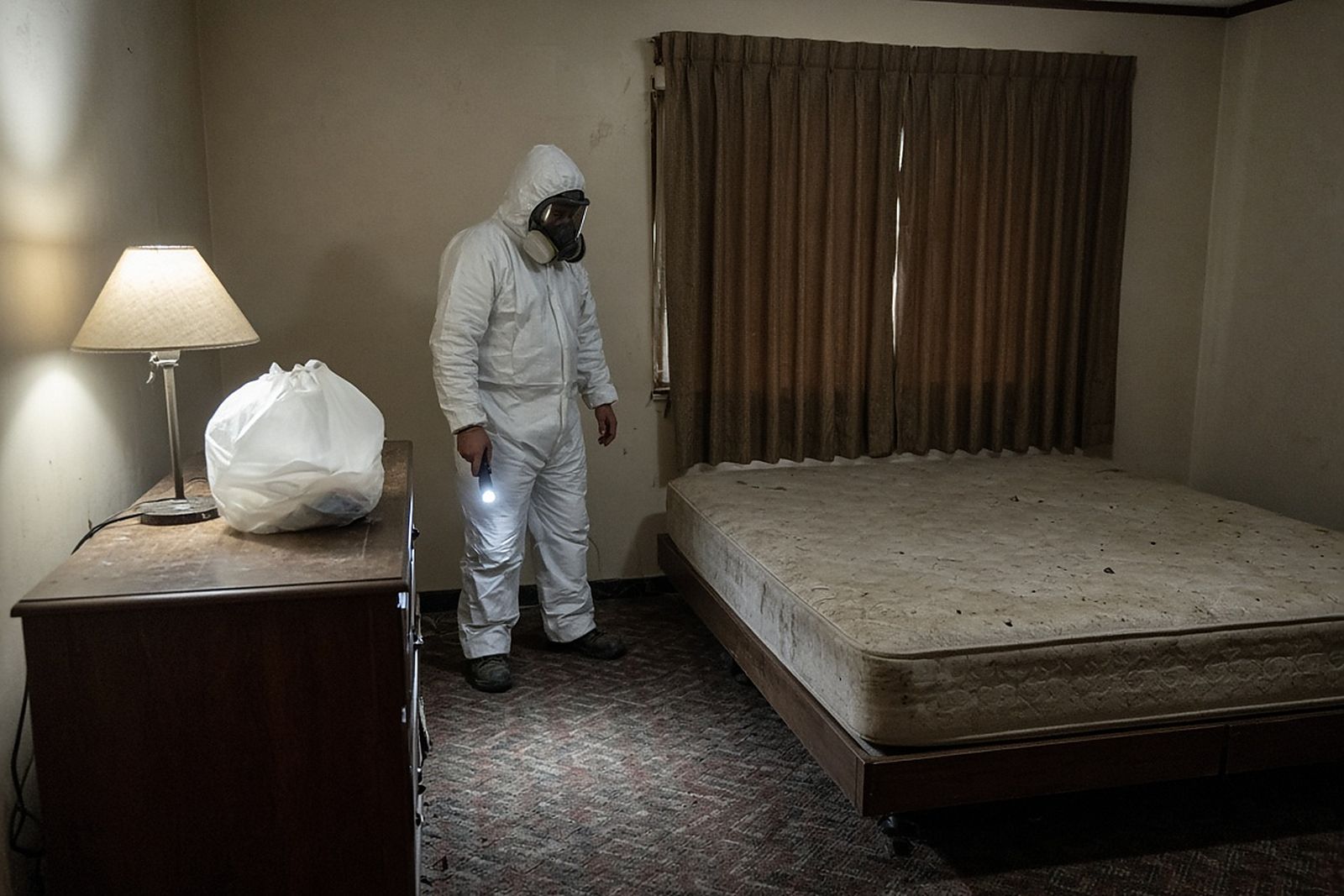
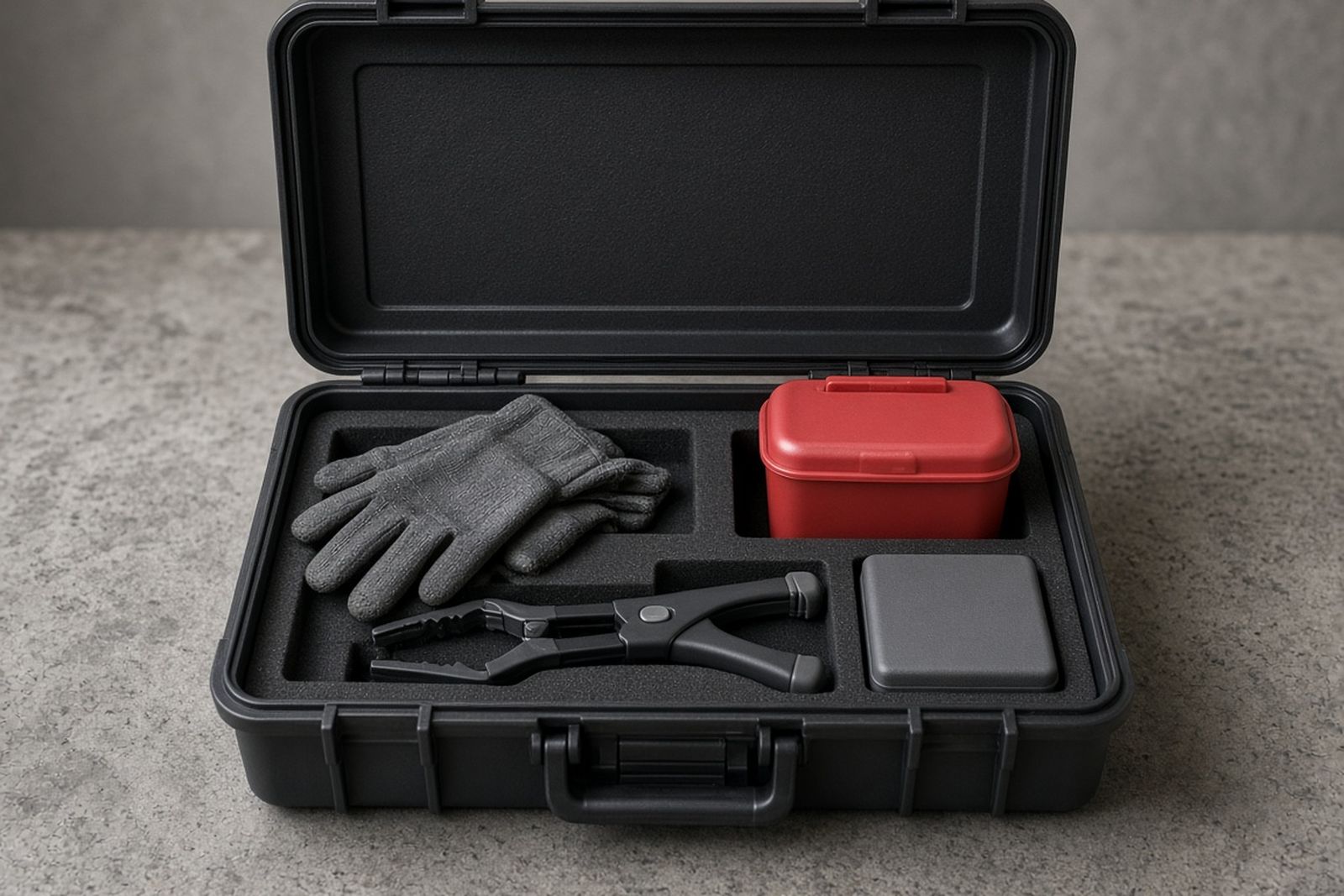
A defensible scope treats search and removal as its own phase, because it carries the highest injury risk and because it determines everything that follows. The lead explains that the crew will search systematically, handle sharps only with tools, place them directly into rigid containers, and keep a running count.
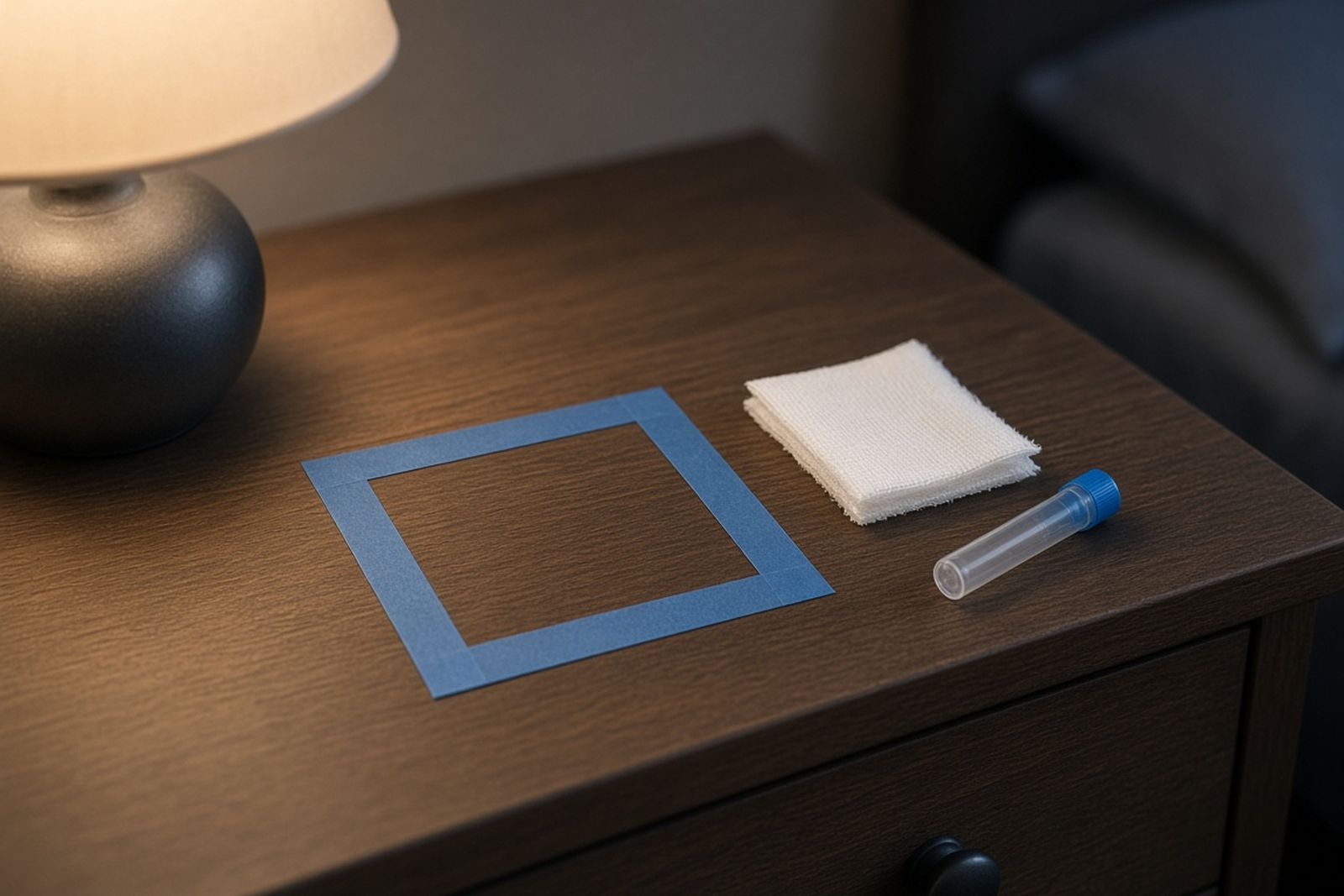
For the powder, the scope specifies that it will not be swept, vacuumed, or brushed. The crew will mist it lightly to keep it from becoming airborne, collect it with wet wipes, and seal it in labeled bags. The EPA, in its 2021 voluntary cleanup guidelines, describes fentanyl particles of 0.2 to 2.0 microns that become airborne easily, which is why dry methods are ruled out when an unknown powder could contain it.
The scope also states what happens if the search reveals something unexpected, such as a large quantity of drugs or a weapon. Work stops, the owner is called, and the crew does not resume until the owner and, if needed, police give direction.
How were decisions about soft goods recorded?
Soft goods are where disputes often start. In this example, the crew's search finds two more syringes inside the pillowcases and one tucked between the mattress and box spring. There is a visible blood spot on the fitted sheet and a burn mark on the bedspread.
The lead photographs each find in place before removal. She then recommends discarding the mattress, box spring, pillows, bedding, and the upholstered chair near the bed, because sharps were hidden in soft goods and blood contacted the mattress surface. The carpet shows no visible staining and no burn marks, so she recommends cleaning rather than removal, with the option to revisit if follow-up testing warrants it.
The owner approves the soft goods disposal in a short written note on the work order. Each discarded item appears on a list with a reason tied to an observation. That list is what makes the decision defensible later if anyone questions it.
Cleaning the hard surfaces
With the room cleared, the scope moves to hard surfaces: the nightstand, the bathroom counter and fixtures, the walls near the bed and bathroom mirror, door handles, the thermostat, the television remote, and the HVAC grille. Each is washed with a detergent solution and wiped in multiple passes. The HVAC filter is replaced.
The testing plan
Because burnt foil suggests smoking, the lead suggests post-cleaning wipe samples from a few surfaces analyzed by a laboratory. She explains that contamination can vary sharply within one space; Wright and colleagues, studying a single home in 2019, found wall-wipe methamphetamine concentrations ranging from 0.54 to 110 micrograms per 100 square centimetres. The owner agrees to sampling on the bathroom counter, the wall above the nightstand, and the HVAC grille.
The scope states which reference values the lab results will be compared against, and it notes that no single federal standard governs personal-use rooms. The provider commits to naming the source of any value it uses so the owner can check it independently.
What defined the finish line?
A scope without a finish line invites both overwork and underwork. Here, the restart condition has four parts: all sharps and paraphernalia removed and counted, all listed soft goods discarded, all listed hard surfaces cleaned, and lab results at or below the agreed reference values. The owner will replace the bed and chair before the room is rented.
If any sample comes back above the reference value, the scope says the affected surface will be cleaned again and resampled, and the owner will be told before any additional work. That clause prevents surprise charges and prevents the room from being rented on the strength of incomplete results.
The lead walks the owner through the finished room, shares photos of each area, and provides the sharps count, the soft goods list, and the waste disposal record. Lab results arrive later and are added to the file.
- Sharps and paraphernalia removed and counted.
- Listed soft goods discarded with reasons recorded.
- Listed hard surfaces cleaned and photographed.
- Lab results at or below agreed reference values.
- Owner sign-off before the room returns to inventory.
What a weak version would have looked like
Compare the scope above with a one-line work order that reads "biohazard cleanup, room 14." That line does not say whether the walkway is included, who can approve extra work, how powder will be handled, or what counts as finished. Every one of those gaps becomes a possible argument later.
A weak scope also tends to bundle everything into a single price with no breakdown. If the crew discovers hidden sharps in the mattress, there is no agreed way to add removal of soft goods, so either the crew absorbs the work quietly and rushes, or the owner receives an unexpected bill with no written approval behind it.
Finally, a weak scope rarely mentions testing or a restart condition. The room gets cleaned, the crew leaves, and the owner is left to decide on her own whether it is safe to rent. When a future guest complains of an odor or finds a stray cap under the dresser, there is no record to show what was searched and what was not.
Lessons that carry over to your property
The details of your situation will differ, but the structure travels well. Define the area. Name who approves changes. Separate search from cleaning. Tie every removal to an observation. Decide how you will know the job is done before the job starts. Keep everything in one file.
It also helps to notice what the owner in this example did not do. She did not let housekeeping tidy up first. She did not throw out bedding herself to save time. She did not rent the room before results came back. Each of those shortcuts would have created risk and weakened the record.
Finally, remember the people behind the scene. The housekeeper who found the room may be shaken, and a quick check-in matters. If a guest or employee is struggling with substance use or is in crisis, local treatment resources and the 988 Suicide and Crisis Lifeline, available by call or text, are there to help.