Short answer
To evaluate equipment for drug paraphernalia cleanup, check that it covers both hazards: sharps and blood on one side, drug residue on the other. Look for no-touch collection tools, rigid sharps containers, sealable waste packaging, protective gear matched to powders or smoke residue, HEPA-filtered vacuums rather than household units, registered disinfectants with known contact times, and a clear plan for testing if residue is suspected.
Why the equipment list is worth a look
Most people hiring a cleanup provider focus on price and availability. Those matter, but the equipment a crew brings says a lot about how they plan to protect themselves, your household, and anyone who uses the space afterward. It is one of the few things you can check before the work starts.
Paraphernalia cleanup has an unusual mix of hazards. There may be needles and blood, which call for sharps handling and disinfection. There may also be drug residue, which calls for dust control and careful packaging. A crew equipped for only one of those is only partly prepared.
You do not need technical expertise to ask good questions. The goal is to see whether each piece of equipment has a clear purpose, and whether the provider can explain it in plain language.
Collection tools for sharps
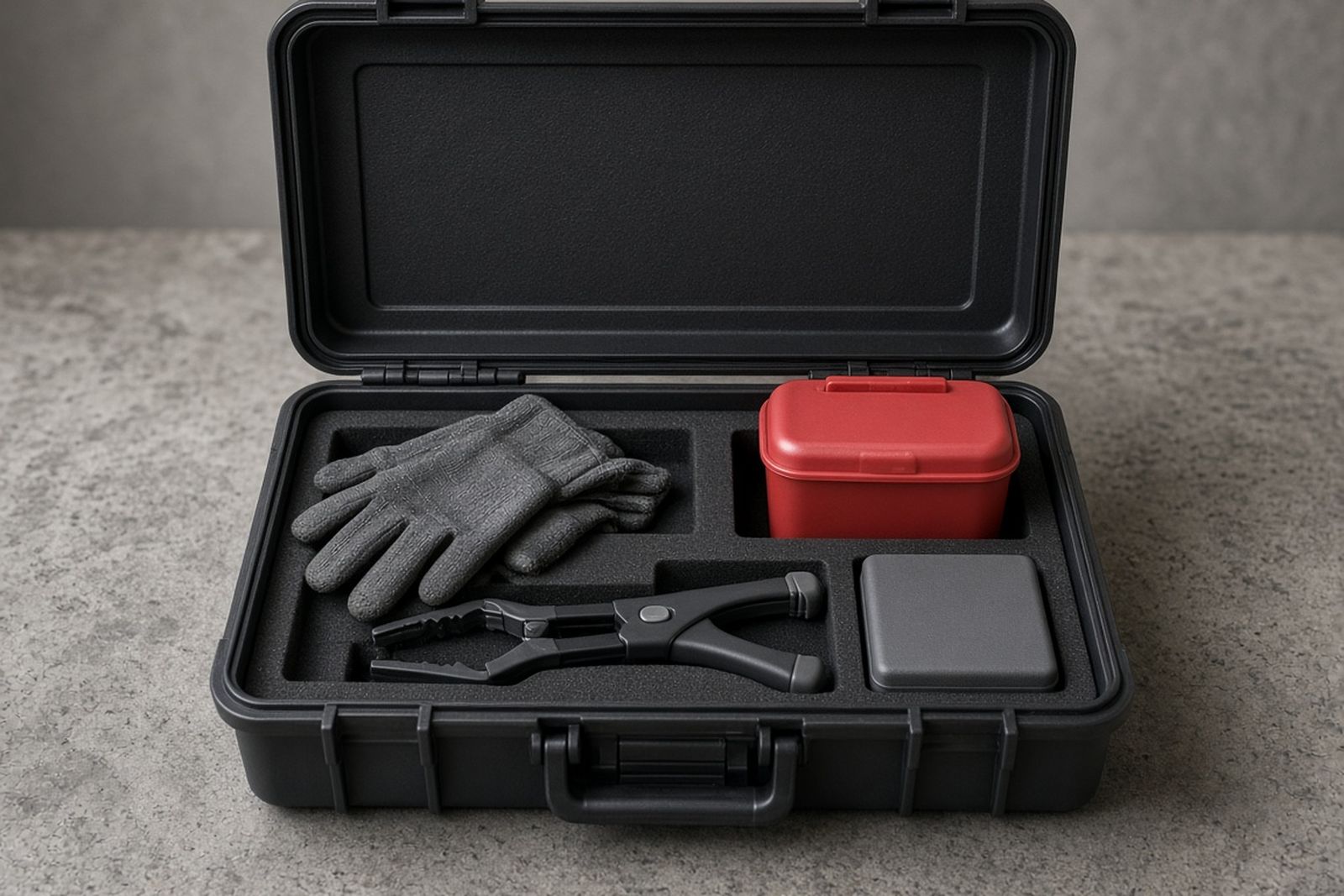
Sharps should never be picked up by hand. A crew should bring no-touch tools such as long-handled grabbers, tongs, or forceps, and they should use them for every needle, whether capped or not. Tools let technicians keep the sharp end pointed away from their bodies and drop it straight into a container.
Containers matter as much as the tools. Look for rigid, puncture-resistant sharps containers with a lid that locks closed. Ask whether they bring several sizes. A small container is fine for a handful of syringes; a larger one is needed if the search turns up many items.
Be wary of anyone who says they will simply bag the needles or put them in a bottle. Thin bags tear, and soft bottles can be pierced, putting the next person who handles the waste at risk.
- No-touch grabbers, tongs, or forceps used for every sharp.
- Rigid, lockable, puncture-resistant sharps containers in several sizes.
- Flashlights, headlamps, and inspection mirrors for hidden spaces.
- A plan to stop filling containers at the fill line.
Lighting and search aids
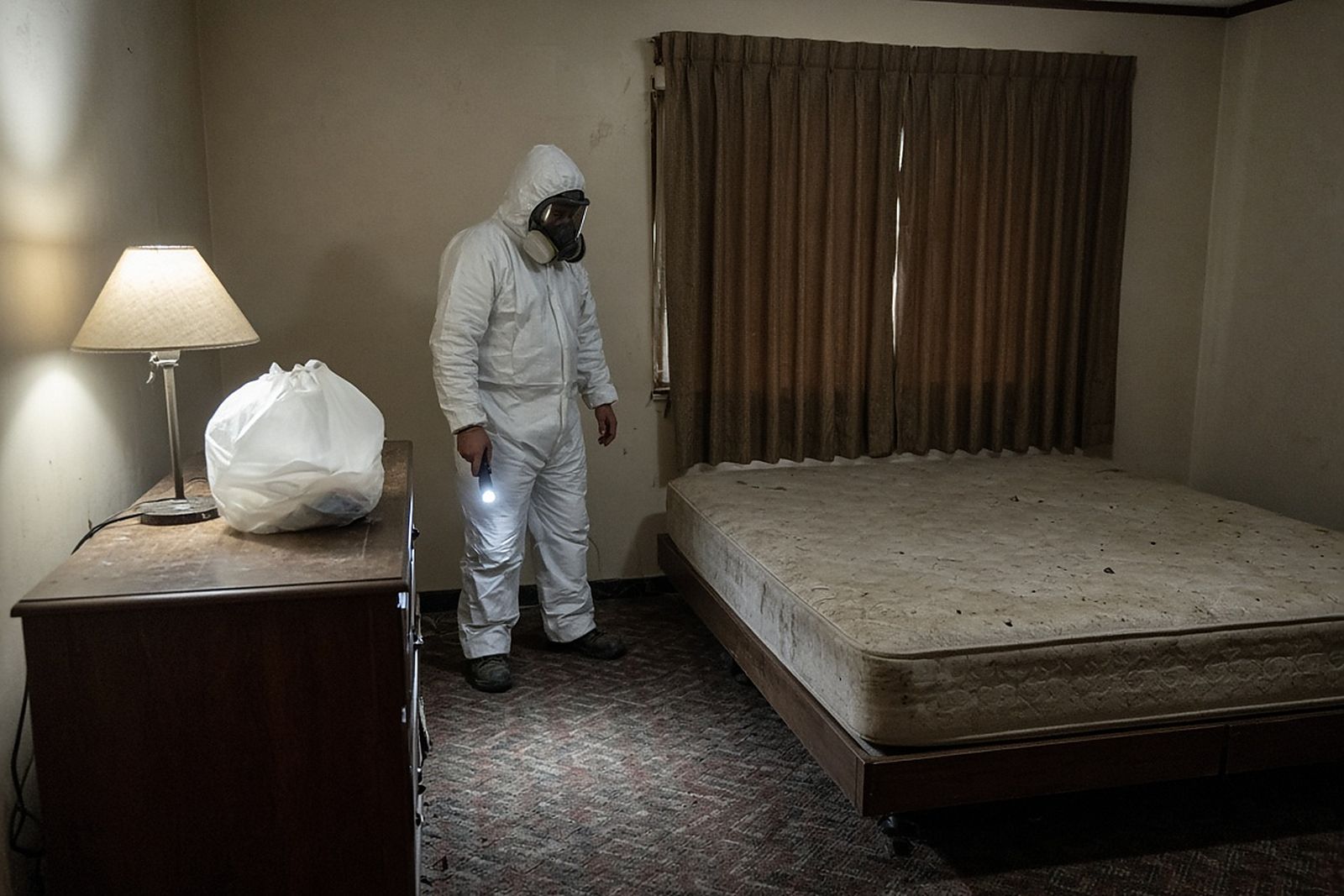
Good crews also bring lighting. Flashlights and headlamps, along with inspection mirrors, let technicians see into drawers, behind appliances, under furniture, and inside vents without reaching in blindly. If a provider cannot describe how they check hidden spaces, ask more questions.
Protective gear, and how to tell if it fits
Protective gear should match the hazard. For sharps and blood, expect disposable nitrile gloves, sometimes layered, plus eye protection and disposable coveralls or sleeves. Some crews use cut-resistant gloves under nitrile, but no glove is fully needle-proof, so gloves are never a substitute for tools and careful technique.
For powder residue, the protection should step up. Crews may use respirators with particulate filters, full coveralls with hoods, and shoe covers. The level of respiratory protection should be chosen by someone trained in the hazard, and the crew should be able to explain why they chose it.
Ask how gear is removed and disposed of. Taking off contaminated gloves and coveralls in the wrong order can transfer residue to skin or clothing. A crew with a set removal routine and waste bags ready at the exit is taking the process seriously.
It is also reasonable to ask whether crew members are trained in overdose response and whether they carry naloxone. That is a sign of a provider that understands the settings they work in.
Why does the vacuum matter so much?
If the job involves powder, fine residue, or dust in carpets, the type of vacuum is one of the most important equipment questions. Household vacuums often release fine particles through their exhaust, spreading residue around the room.
Professional crews should use vacuums with HEPA filtration designed to capture very fine particles. The filter should be sealed within the unit so air cannot bypass it. Ask how the crew empties and cleans the vacuum after the job, since the collected material is itself contaminated.
Even with a good vacuum, it should not be the first tool used on visible powder. Most crews dampen and wipe first to keep particles from becoming airborne, then vacuum to capture what remains. A provider who plans to start by vacuuming visible powder should be asked why.
Containment supplies
For heavier residue, a crew may bring plastic sheeting, tape, and zipper doors to close off the work area, plus a way to keep the building's air handling from carrying particles into other rooms. Ask whether they plan to isolate the space and how.
Cleaning products and disinfectants
For blood and biological material, crews should use a disinfectant registered for bloodborne pathogens, applied after surfaces are cleaned and left wet for the full label contact time. Ask which product they plan to use and how long it needs to stay wet.
Bleach solutions are a common choice for hard surfaces, but the product has to suit the surface and be mixed at the dilution on its label. More concentrated is not better, and bleach should never be combined with other cleaners.
For drug residue, cleaning is often more important than disinfecting. Detergent solutions and disposable wipes lift residue from surfaces. Crews should change wipes frequently and fold them inward to avoid spreading residue. Ask whether the product they plan to use is compatible with your surfaces, since some chemicals damage stone, wood, or fabrics.
Packaging and transport
Everything collected needs appropriate packaging. Sharps go in rigid containers. Blood-soaked items and contaminated soft goods go in heavy, leak-resistant bags, sometimes double-bagged, and may be placed in rigid outer boxes or drums for transport. Bags containing possible drug residue should be sealed without being opened or compressed.
Ask how the provider labels waste and where it will go. Some materials may be treated as regulated medical waste; others may be handled as ordinary solid waste after bagging. Your county health department or solid waste office can confirm how paraphernalia and contaminated materials must be managed in your area.
A provider should be able to give you documentation showing that waste was taken to an appropriate facility. That record is especially useful for landlords, property managers, and businesses.
When is surface testing equipment worth asking about?
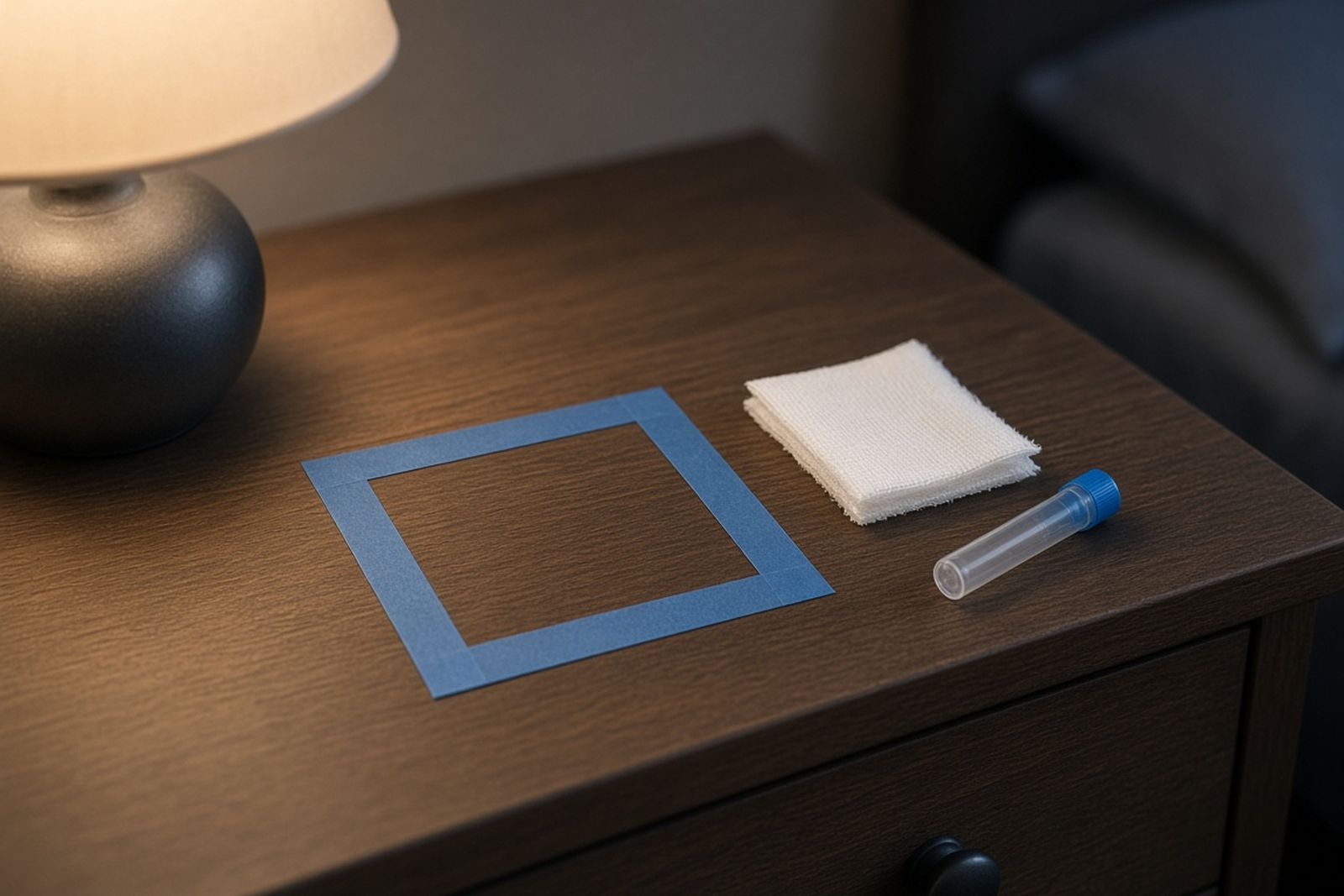
Where powders were handled or a space is suspected of heavy use, some providers offer wipe sampling. They use sampling kits with pre-moistened wipes, templates to mark a set surface area, and sealed containers to send samples to a lab. Testing can show whether residue remains after cleaning.
Residue can end up in unexpected places. A 2026 study in the Journal of Occupational and Environmental Hygiene by NIOSH authors found that 8 of 86 surface wipes across 11 forensic labs exceeded the ACGIH fentanyl surface limit of 10 ng/cm2, including on keyboards, scales, and return-air vents. Homes are not labs, but the finding is a reminder to ask where samples will be taken, not just whether they will be taken.
Guidance on acceptable levels varies. Some state health departments publish their own benchmarks, while other places have none. Ask the provider which benchmark they will use, which lab will analyze the samples, and how results will be reported to you.
What a complete equipment plan includes
For a room with syringes, burnt foil, and scattered white powder, a complete answer to the equipment question covers both hazards at once. It names grabbers and sharps containers for the syringes, respirators and full coveralls because of the powder, and dampened wipes for surfaces before any vacuuming.
It continues with a HEPA vacuum for the carpet once visible powder is gone, a registered disinfectant with a stated contact time for any blood, sealed bags for soft goods such as bedding and curtains, and optional wipe sampling if you want confirmation before the space is used again.
Compare that with a plan that amounts to gloves, trash bags, and a promise to be done in an hour. A complete plan tells you the provider understands what is in the room, and it gives you something concrete to compare with other bids and to show an insurer or inspector who later asks how the space was handled.
Six equipment questions before you hire
Keep your questions simple and specific. Good providers welcome them.
If a provider cannot answer clearly, or dismisses the questions, consider that a warning sign. If the discovery involves someone close to you, remember that you do not have to be present for the work. If anyone is in crisis, the 988 Suicide and Crisis Lifeline is available by call or text at 988.
- What tools will you use to collect sharps, and what containers will they go into?
- What protective gear will your crew wear, and why that level?
- What type of vacuum will you use, and when in the process?
- Which disinfectant will you use, and what is its contact time?
- How will waste be packaged, labeled, and where will it go?
- Do you offer surface testing, and what benchmark will you use?